
In April 2025 the operator of Berlin’s A100 told the city that emergency vehicles may use the Halenseebrücke only up to 3,5 tonnes. Not that they should avoid it. That ambulances, fire appliances and turntable ladders must find another way across:
Das Bauwerk ist für Feuerwehrfahrzeuge über 3,5 Tonnen nicht passierbar.
The Berliner Feuerwehr expects significant restrictions on its response into that part of the city. No blue light changes any of it, because the limit is structural. The bridge does not care what the crew is entitled to do.
That is what a weight limit looks like when it is real.
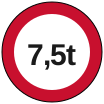
Most of the roundels you meet are not the Halenseebrücke. They are through-traffic measures, put up to keep lorries out of somewhere unsuitable, and whether they apply to an appliance at all is a question of national law. A truck sat nav answers that question the same way every time, in every country: avoid.
One sign, three legal answers
In the Netherlands the permission is as broad as drafting gets. Article 91 of the RVV 1990 is a single sentence: “Bestuurders van een voorrangsvoertuig mogen afwijken van de voorschriften van dit besluit voor zover de uitoefening van hun taak dit vereist”. Drivers of a priority vehicle may depart from the provisions of this decree insofar as the performance of their task requires it. The duty to obey a sign is itself a provision of that decree, so the weight roundel sits inside the exemption.
In Germany, §35 StVO grants the fire service Sonderrechte independently of the blue light, which is broader still on its face.
In France, R432-1 disapplies only the rules of “le présent livre”, Book IV of the Code de la route, and only while the two-tone horn and beacons are actually running. A French tonnage limit is usually not made under Book IV at all. It is a local arrêté made by a mayor or prefect under separate legislation, so the exemption may not reach it by its own force.
In practice French arrêtés tend to carve out the emergency services by name. The permanent 3,5 t limit on the pont de Salbart at Échiré exempts “les services de secours” explicitly, on a structural bridge limit at that. But the government’s own model arrêté for a tonnage restriction contains no exemption clause whatsoever. Whether you are exempt can come down to who drafted the document for that particular bridge.
Three countries, three answers, one behaviour from the software. It is the correct behaviour for a haulier in all of them, and the wrong one for an appliance in at least two.
The bridges are not getting better
This matters more every year, because the number of restricted structures keeps climbing.
Amsterdam is the clearest case. Its bridges and quay walls programme reports that, with repairs not keeping pace with the maintenance backlog, weight restrictions are being imposed more and more often: 120 on quay walls and 35 on bridges since the programme began, with 23 sections restricted to 30 t, ten to 7,5 t and six to 3,5 t. The city’s own assessment is that allowing heavy traffic in areas like the Wallen is no longer tenable.
The fire service is legally exempt from every one of those. It has still publicly flagged access for emergency services as a risk, which is exactly the point: an exemption removes a fine, never a load rating.
And nobody is telling the driver which kind they are looking at. We searched both national Dutch fire service Brancherichtlijnen for any treatment of vehicle mass, bridge loading or the weight sign. There is none. The broadest legal permission in Europe, and no operational guidance at all on whether the deck will hold.
Cerema, the French state agency that advises municipalities on precisely this, is admirably honest about why:
Il n’est pas possible de déterminer « dans l’absolu » LA charge maximale admissible sur un pont.
There is no such thing as the maximum load a bridge will take. What can be assessed is whether one specific, defined vehicle, “par exemple un camion de pompiers”, is admissible for that structure.
Which is the question a routing engine should be asking
Not “is this road restricted”, but “is this appliance admissible on it, and who decided that”.
Blue Light Maps works from the appliance you are actually on: its width, height and gross weight. Weight restrictions can be respected everywhere, or a service can flag individual structures, so routes avoid the quay in the old town while leaving the through-traffic restrictions alone. Every limit a route crosses or steers around is marked on the map, so the crew sees the decision instead of inheriting it.
There will always be a Halenseebrücke, and software cannot tell you the deck holds. What it can stop doing is giving one answer to a sign that means three different things.