
A single-crewed officer pulls up first at a 2am domestic. A solo paramedic reaches an RTC before the ambulance. The first pump arrives at a persons-reported fire with the second still somewhere behind them. Three different services, and the same decision underneath: act now, or hold for the crew that’s coming?
That decision is only as good as one piece of information: how far away the others are. And in most services, the only tool for getting it is the radio.
The most asked question on the channel
“What’s your ETA?” It’s asked on nearly every multi-unit response, and the exchange fails in three quiet ways.
The person answering is driving, at speed, and the question interrupts exactly the person who can least afford it. The answer is a guess. And it’s stale the moment it’s spoken, because an ETA is a dynamic number and a radio message is not.
Meanwhile the exchange is occupying the channel at the busiest moment of the incident.
The number already exists
Here’s what makes this problem unusual: nobody needs to produce any new information to solve it. Both crews are running navigation. Each app is already computing a continuously updated arrival time, grounded in the vehicle’s real position, its routing profile, and what it’s entitled to do under blue lights.
The number exists. It’s just trapped in the one cab that doesn’t need it.
We take the arrival time each crew’s navigation is already showing, and put it in front of the other crews on the same job. In Blue Light Maps, that looks like a small panel under the turn instructions: each attending unit’s callsign, a status dot, and a live time. The time reads relative to your own arrival, because that’s the form the decision needs: +2 min is a colleague arriving two minutes behind you.
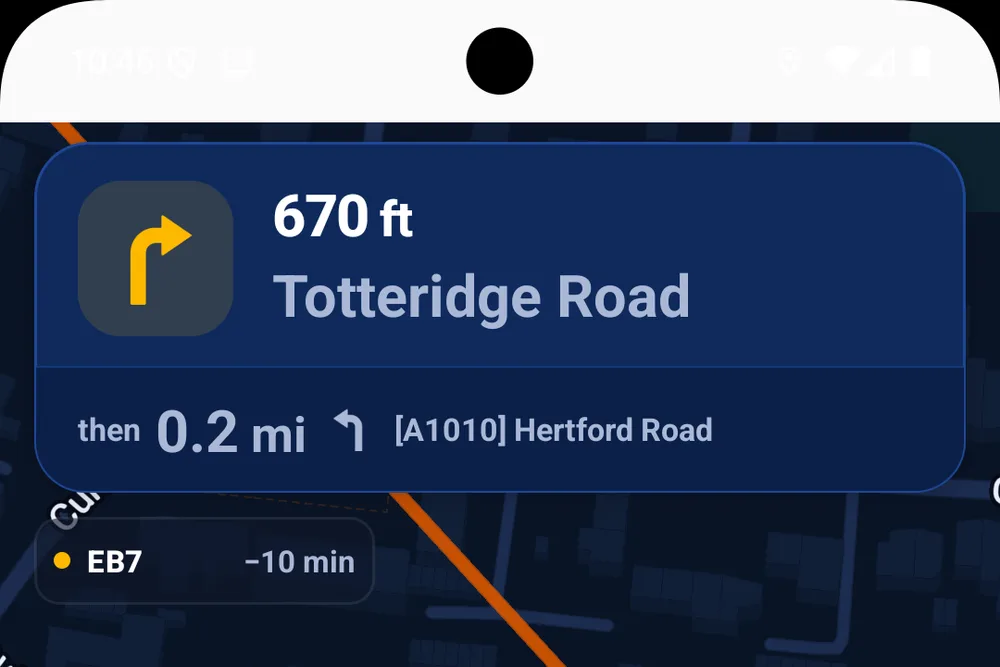
Here, EB7 lands ten minutes before this crew does. Nobody asked.
When you arrive first, the panel stays up, showing who’s still inbound and how far out. The units appear on the map, too, which turns “two minutes away” into “two minutes away, approaching from the bypass side”. Worth knowing before you commit to a door or an approach on foot.
What changes on the ground
The officer at the domestic sees backup at +1 min and holds; at +9 min it’s a different job and a different decision, and now it’s based on data rather than a guess. The first-arriving fire officer sets tactics based on knowing whether the second appliance lands in one minute or six. The solo paramedic sees the truck’s actual ETA and decides what can safely wait for it, and nobody has keyed up.
The radio still does what only the radio can do. Detailed updates, decisions, the things control needs on the record. What disappears is the navigational chatter: the asking, the guessing, the re-asking when different resources get assigned.
Where it ships
Shared ETAs are part of shared overlays, alongside live location sharing, cordons, RVPs and sector boundaries. They ship on Android, iOS and Windows, and are drawn straight onto CarPlay and Android Auto so the head unit shows the same picture as the handheld. How to set a callsign, join a sharing group, and read the status dots is covered in the documentation.