Lights and sirens are often noticed at the last-second. By the time a driver sees blue lights in the mirror or hears the siren over their music, there’s little time to react calmly, so they often brake late, swerve, or freeze.
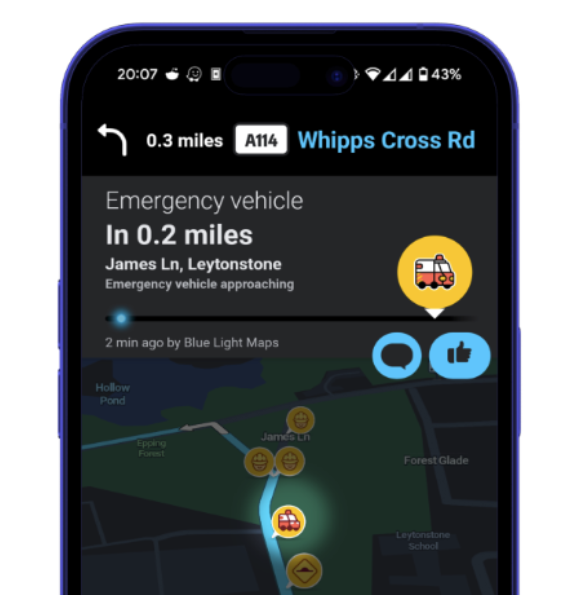
Blue Light Alert® gets ahead of that. During navigation to an emergency call, we broadcast an approaching emergency vehicle alert into Waze along the route - reaching drivers before they can see or hear the emergency vehicle coming, giving them more time to notice and to move over.
Why a head start matters
The danger in blue light driving isn’t only that other drivers don’t slow down, it’s variability. Some brake hard, some don’t slow at all, and that unpredictability is what causes collisions and impacts response times.
A warning that arrives early lets drivers adjust smoothly, together, well before the blues appear in their mirror, reacting 4× further out than they would to lights alone.
The evidence
Independent research backs this up. A 2026 University of Illinois field study filmed thousands of vehicles approaching live roadside scenes from the air, comparing how they behaved with and without an in-vehicle digital alert. A University of Minnesota study put 85 drivers through emergency-vehicle encounters at junctions in a driving simulator.
Both found the same thing: drivers warned before they can see a vehicle react sooner, more smoothly, and collide far less often.
Reaction-distance & speed-variability figures: University of Illinois & Illinois Center for Transportation, FHWA-ICT-26-003 (2026). Collision-risk figure: Drucker, C.J. (2013), University of Minnesota (odds ratio 0.30, simulator phase, n=85).
How it works
- An incident is dispatched to crews using your existing systems.
- The responding crew uses Blue Light Maps in ‘emergency’ mode to navigate to the incident.
- Blue Light Alert® automatically broadcasts approaching emergency vehicle alerts into Waze along the route, and stationary emergency vehicle alerts for incidents on fast roads.
Crews never touch Waze themselves. It warns the drivers ahead, and Blue Light Maps does the routing. Why we route with one and warn through the other.
More accurate, because we know the route
Hardware beacons and location-only services can only flag that an emergency vehicle is somewhere nearby, right now. Because Blue Light Alert® runs on the responding crew’s live navigation, we know the exact route they’re taking. That means we warn the right drivers earlier and with fewer false alarms for everyone else.
How this compares with HAAS Alert.
The cost of doing nothing
Source: FOI request to Thames Valley Police.