
Recovery from a medical emergency can be a bumpy ride. That doesn’t mean the journey to the hospital has to be one too.
While EMS and ambulance crews do their best to get patients to the hospital as quickly as possible, they also often drive through streets and neighbourhoods that have speed humps, potholes, and other obstacles that can make the ride uncomfortable, or even unsafe, for patients.
Clinical research
Research has shown that ambulances need to slow significantly at speed humps to avoid negative consequences, delaying ambulances by 5.7 – 9.4 seconds per speed hump¹. When driving over a hump at 24 km/h (15 mph), a patient onboard experiences significant discomfort and a significant impact on their physical health and well-being (especially if they have fractures or spinal injuries). Even at 16 km/h (10 mph) discomfort is still felt, with the possibility of negative health implications for patients with spinal injuries².
In more critical situations where CPR is being administered, chest compressions have been shown to be less effective when encountering speed humps and sudden deceleration. Simulations show that vehicle movements in these conditions result in incorrect hand position, hindering effective CPR³. Paramedics agree, with 89% saying that speed humps have interfered with CPR.
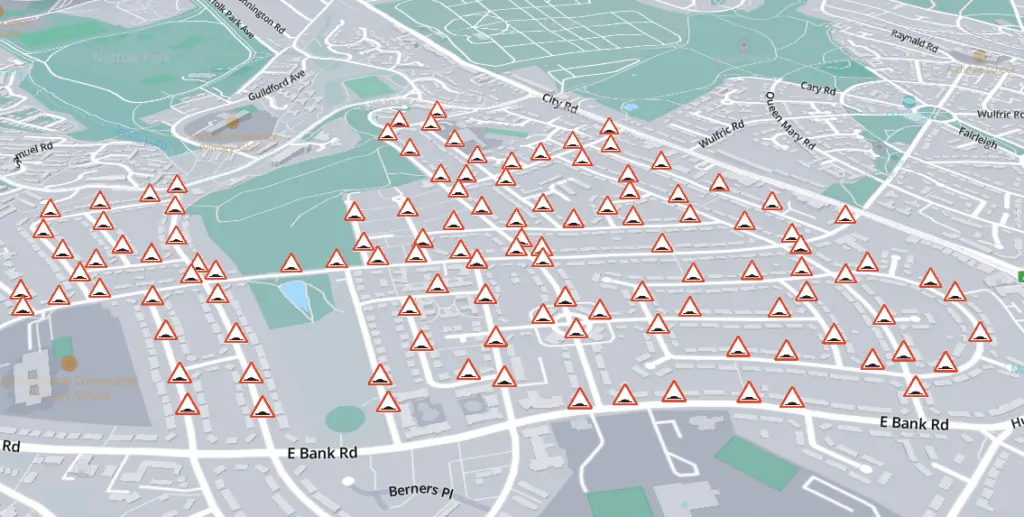
Moreover, a study suggests that 80% of frontline paramedics would prefer to alter the route to hospital to avoid speed humps with a medically stable patient, and 59% would wish to do so with an unstable patient – even if that resulted in a route that was up to 4 minutes longer.⁴
How we can help
Our mobile app uses custom routing algorithms to generate the most suitable routes to hospital, including Blue Light Routing, which finds direct routes that take into account exemptions from traffic restrictions. Additionally, we can provide ambulance crews the option to avoid routes that have speed humps.
Blue Light Maps is the only navigation solution that specifically takes speed humps into account when generating routes. Other solutions typically generate routes based on the expected average speed along a road, without the capability to avoid individual road features like speed humps.
Our GPS navigation solution offers a number of advantages for patient safety and comfort. Namely:
- Smooth ride: By avoiding speed humps and other obstacles, we can help ensure a smoother, more comfortable ride for patients. This can be especially important for patients with pre-existing medical conditions or those who are already experiencing discomfort or pain.
- Reduced risk of injury: Speed humps can pose a risk of injury to patients, particularly if the ambulance hits them at high speeds. This is more likely when the driver is in a hurry and experiencing cognitive overload. A navigation app that avoids these types of obstacles can help reduce the risk of injury to patients.
- Reduced stress: For many patients, the ambulance ride can be a stressful and anxious experience. Anything that can be done to make the ride more comfortable can help reduce stress and anxiety for patients.
- Increased efficiency: By generating the most efficient routes to the hospital, Blue Light Maps can help ensure that patients get the medical attention they need as quickly as possible. This includes enabling ambulance crews to administer medical interventions safely en-route to hospital, which might otherwise be delayed due to unsuitable road conditions.
References
- Öz et al., Effect of Speed Humps on Ambulance Delay (2023)
- Kosakowska, Evaluation of the impact of speed bumps on the safety of residents (2022)
- Beom et al. Evaluation of the quality of cardiopulmonary resuscitation according to vehicle driving pattern, using a virtual reality ambulance driving system: a prospective, cross-over, randomised study (2018)
- M. Belchamber, A study of paramedics’ attitudes to the effects of speed humps on resuscitation of patients en route to hospital, including general patient care and ambulance response times (2003)