Ask a fire service why its crews are running a truck sat nav and the answer is a sensible one. It is the only thing available off the shelf that knows the appliance is 3.5 metres tall and weighs 13 tonnes, and getting that wrong means a bridge strike. So services reach for the product built around vehicle dimensions.
The instinct is right. The tool is wrong.
A haulier’s sat nav has one job
HGV navigation apps treat every restriction as absolute. Sygic Truck, TomTom, CoPilot and Garmin dēzl are all built for drivers whose livelihood depends on never crossing a plated bridge. The penalty is a fine, points, and a conversation with the traffic commissioner about the operator’s licence. There is no version of the job where routing over a 7.5 tonne limit is the right answer, so the software never does it.
That is correct behaviour for a lorry. Applied to a fire appliance, it is precisely backwards.
A pump has exemptions
Most weight limits are not statements about what a bridge will carry. They are environmental restrictions, made by a local authority under a Traffic Regulation Order to keep heavy through-traffic out of places that cannot absorb it: village high streets, canal crossings, residential streets being used as rat runs.
Plenty of the limits that do sit on bridges carry an exemption for emergency services, written in on the basis that an appliance crosses a handful of times a year rather than forty times a day.
A lorry sat nav cannot act on any of that. It sees a number in a red ring and routes around it.
Eleven minutes
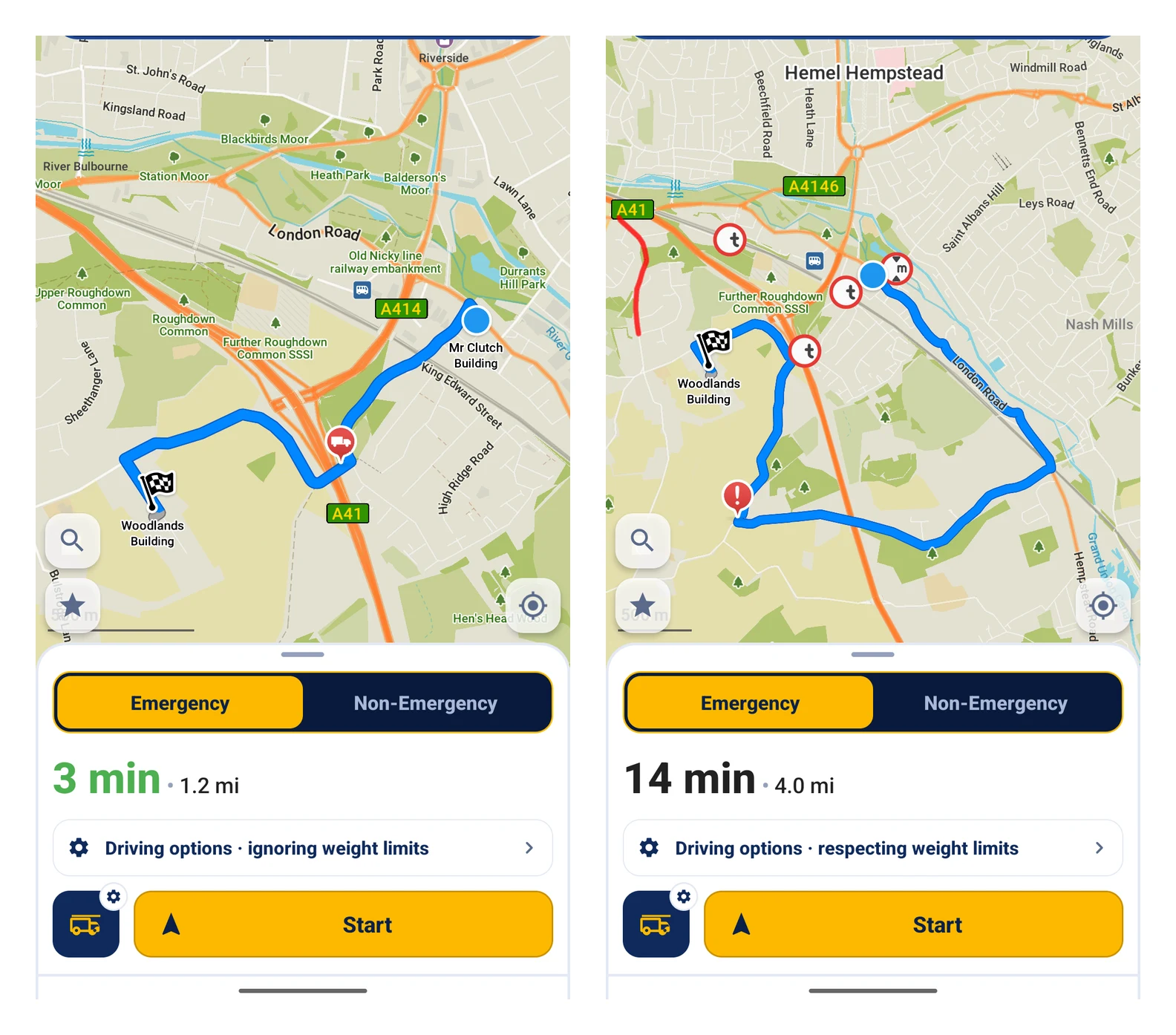
Same appliance, same destination, both in emergency mode. The only thing that changes between these two screens is whether the software believes a weight limit applies to a fire engine.
Ignoring the limits: 3 minutes, 1.2 miles. Respecting them: 14 minutes, 4.0 miles. The direct route runs straight down and over the restricted crossing. The compliant one goes out around the common and comes back on itself, and every red marker on that second screen is a limit the route was forced to avoid.
Eleven minutes is not a routing inefficiency. On a developing fire, eleven minutes is most of the incident.
The gap the blue light products leave
This is not only a criticism of the truck apps. Weight limits get missed by navigation products built specifically for emergency services too, and there is a structural reason why.
The well-known exemptions are the ones you can reason about without knowing anything at all about the vehicle. Bus gates and restricted turns: a response car and a 13 tonne pump are treated identically, so a product can handle them without ever asking how big you are. Weight is the awkward one. It is a vehicle dimensions problem and a legal exemption problem simultaneously, and it only gets solved if a product does both. Most do one.
Where it genuinely stops
None of this makes every restriction negotiable.
Height and width are not exemptable and never will be. A 3.2 metre bridge stops a 3.5 metre appliance whatever the blue lights are doing. Some weight limits really are structural, too: a plated limit can reflect what the deck will actually carry, and no Traffic Regulation Order makes a weak bridge stronger.
The difference is what the software does with that. A navigation system built for the job puts the decision in front of the driver rather than making it for them. Blue Light Maps routes across an exemptable weight limit and marks the road it crossed, so the crew know exactly what they have been sent over. Where a service has a local instruction about a particular bridge, a crew can tell the app to respect that one limit and leave the rest alone.
A lorry sat nav cannot make that distinction either. It just says no to all of them, which looks like caution, and costs eleven minutes.
We’ve also compared Blue Light Maps side by side with TomTom and with Sygic’s professional emergency product.